en
en  English
 中文简体
中文简体 Español
 عربى
عربى

Product Consultation
Your email address will not be published. Required fields are marked *
The term "bicomponent fiber" covers a broad family of engineered fibers that share one defining characteristic: each individual fiber contains two distinct polymer components arranged in a specific cross-sectional geometry. That geometry — how the two polymers are positioned relative to each other — determines everything about how the fiber behaves in end-use applications. The same two polymers arranged differently produce fibers with radically different properties, which is why understanding the fiber configuration matters as much as knowing the polymer combination.
Most fiber properties are bound by what a single polymer can achieve. Polyester is strong and dimensionally stable, but doesn't bond well with heat. Polypropylene bonds at lower temperatures but has lower tensile strength. Polyethylene has excellent softness but poor shape retention. Nylon is tough and elastic, but expensive at scale.
Bicomponent fiber engineering circumvents these single-polymer limitations by combining two materials so that each contributes its best properties to the final fiber. A polyester/polyethylene (PET/PE) sheath-core fiber, for example, uses polyester's structural strength as the load-bearing core while polyethylene's low melting point on the sheath creates thermal bonding capability — the fiber can be bonded into a nonwoven fabric at temperatures where polyester remains solid and unaffected. Neither polymer alone achieves this combination.
The result is a category of fibers that enables product designs impossible with single-component materials: self-crimping pillow fill, thermally bondable nonwovens, ultra-fine microfibers from splitting fiber, elastic-recovery staple fiber, and high-bulk batting materials.
The sheath-core configuration places one polymer as a continuous outer layer (the sheath) surrounding the other polymer at the center (the core). In the concentric version, the core runs through the exact center of the fiber. In the eccentric version, the core is offset to one side.
Concentric sheath-core fibers are the most widely used bicomponent configuration for thermal bonding applications in nonwovens. The combination of a low-melting-point sheath (polyethylene, co-PET, or co-PA) over a high-melting-point core (PET, PP, or PA6) allows the sheath to melt and flow during heat consolidation while the core maintains its fiber structure. This creates bonded intersection points in the nonwoven web without melting the fibers themselves — the result is a fabric with structural integrity, defined thickness, and controlled density. Applications include hygiene product coverstock, medical nonwovens, automotive interior fabrics, and filtration media.
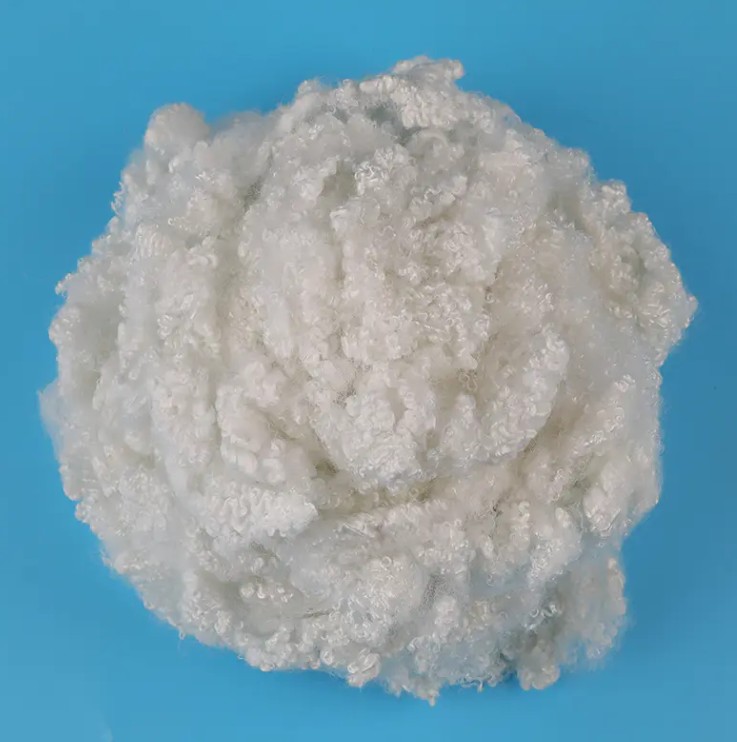
Eccentric sheath-core fibers behave very differently. Because the core is offset, the two polymers have different cross-sectional positions and experience different stress during fiber cooling after spinning. This differential shrinkage creates a three-dimensional helical crimp in the fiber — the fiber spontaneously coils like a spring. Eccentric sheath-core fibers are the primary engineering approach for producing self-crimping, high-bulk fibers for pillow fill, cushion stuffing, and insulation batting applications. The crimp level is controlled by the degree of eccentricity and the difference in shrinkage characteristics between the two polymers.
In side-by-side bicomponent fibers, the two polymers run as parallel segments along the full length of the fiber, each occupying approximately half the cross-section. Like eccentric sheath-core fibers, the differential shrinkage between the two components during processing generates helical crimping, but in a side-by-side configuration, the crimp is typically stronger and more durable because both polymer phases are fully exposed to the thermal cycling that drives the crimp development.
Side-by-side bicomponent fibers are used where strong, consistent three-dimensional crimp is required: high-loft batting, pillow fill that must maintain recovery over many compression-and-release cycles, and insulation materials where loft retention over the product's service life matters. The elastic recovery of a well-designed side-by-side bicomponent fiber significantly exceeds that of a mechanically crimped single-component fiber — the crimp is driven by internal stresses in the polymer structure rather than being an external shape imposed on the fiber, so it doesn't permanently set under sustained compression.
The islands-in-the-sea configuration embeds multiple "island" polymer fibrils — often 16, 32, or 64 per cross-section — within a "sea" polymer matrix. The islands and sea are different polymers, and after fiber spinning and web formation, the sea polymer is dissolved or mechanically split away, leaving the individual island fibrils as ultra-fine fibers that are a fraction of the original fiber diameter.
This configuration is the primary production route for microfibers and ultra-fine fibers in the 0.01–0.3 denier range — fineness levels that cannot be achieved by direct spinning. The end fibers produced from splitting a 2-denier islands-in-the-sea fiber with 64 islands are each approximately 0.03 denier, thin enough to produce suede-like synthetic leather surfaces, very high-density filtration media, and ultra-fine nonwoven fabrics with surface areas and softness that coarser fibers cannot match.
Segmented pie bicomponent fibers arrange the two polymers as alternating pie-slice segments, typically 8 or 16 segments, meeting at the fiber center. The two polymers have low interfacial adhesion by design, so when the fiber is subjected to mechanical splitting forces — high-pressure water jets in spunlace processing, or specific chemical treatments — the segments separate at the polymer interfaces, producing wedge-shaped microfiber segments with very high surface area and sharp edges.
The sharp-edged segmented pie geometry is what makes these fibers particularly effective for cleaning applications: the wedge-shaped cross-sections create strong capillary action for liquid absorption and retention, and the edges provide mechanical cleaning action. Microfiber cleaning cloths, wipes, and mops produced from split segmented pie bicomponent fibers outperform conventionally woven fabrics in both absorption capacity and particulate removal. This is the fiber engineering behind most high-performance microfiber cleaning products.
ES fiber — a polyethylene/polypropylene sheath-core bicomponent — is the most commercially significant single bicomponent fiber type in the nonwoven industry. The name comes from the original Japanese manufacturer designation (Ess fiber), and the configuration is a concentric sheath-core with a polyethylene or modified polyethylene sheath over a polypropylene core.
The processing logic is straightforward: polypropylene melts at approximately 160–170°C; polyethylene melts at 125–135°C. During calendar bonding or through-air bonding of a nonwoven web containing ES fiber, the processing temperature is set between these two melting points — the PE sheath melts and flows to create bonded contact points while the PP core remains solid and maintains the fiber's structural integrity. The result is a bonded nonwoven fabric with defined porosity, controlled thickness, and predictable mechanical properties.
ES fiber is specified for hygiene nonwovens (diaper topsheet and acquisition layer), facial mask substrate, filtration media, wet wipes substrate, agricultural fabrics, and any nonwoven application requiring thermal bonding with predictable and controllable bond strength. Variations in PE/PP ratio, fiber fineness (1.5D, 2D, 3D, 4D, 6D are common), fiber length, and PE sheath modification allow ES fiber to be optimized for specific end-use requirements across this broad application range.
| Configuration | Key Mechanism | Primary Advantage | Main Applications |
|---|---|---|---|
| Concentric sheath-core | Differential melting point | Thermal bonding without structural fiber damage | Hygiene nonwovens, filtration, medical fabrics |
| Eccentric sheath-core | Differential shrinkage → helical crimp | Self-crimping for high-bulk, good elastic recovery | Pillow fill, cushion batting, insulation |
| Side-by-side | Strong differential shrinkage → durable crimp | Superior loft retention, excellent crimp recovery | High-loft batting, pillow fill, insulation products |
| Islands-in-the-sea | Sea dissolution → ultra-fine islands released | Ultra-fine fiber production below direct-spin limits | Synthetic suede, ultra-fine filtration, luxury nonwovens |
| Segmented pie | Mechanical/hydraulic splitting at polymer interface | High surface area, wedge-shaped cross-section | Microfiber cleaning products, high-absorption wipes |
| ES fiber (PE/PP sheath-core) | PE sheath melts, PP core maintains structure | Precise, controllable thermal bonding | Hygiene coverstock, wipes substrate, agricultural |
When specifying bicomponent fibers for production use, the following parameters determine end-product performance and should be confirmed before ordering:
Fiber fineness (denier or dtex): Finer fibers produce a softer hand feel and denser fabric construction; coarser fibers provide more bulk and structural resilience. For hygiene nonwovens, 1.5–2D is standard for coverstock; 3–6D for acquisition layers. For pillow fill, 3–7D eccentric or side-by-side fibers are typical, depending on target loft and softness.
Cut length: For staple fiber applications in nonwovens, 38mm and 51mm are the most common cut lengths for carding-based processes. Airlaid nonwoven processes typically use shorter cut lengths (5–12mm). Spinning applications use longer staple lengths matched to the spinning system.
Crimp level and crimp permanence: For filling and batting applications, both the initial crimp level (expressed as crimps per centimeter) and crimp retention after compression-and-recovery cycling are important specifications. Ask for crimp retention data from compression testing, not just initial crimp count.
Bonding temperature window: For thermal bonding applications, the window between sheath melt temperature and core melt temperature determines processing latitude. A narrow window requires tighter process control; a wider window is more forgiving for high-speed production lines.
Recycled content and certifications: Recycled polyester bicomponent fibers are available for most configurations and carry GRS (Global Recycled Standard) certification for supply chains requiring documented recycled content. Confirm certification scope and traceability documentation before specifying for sustainability-branded products.
Regular polyester staple fiber (single-component PET) can be used in nonwovens but requires either resin bonding, needle-punching, or spunlace processing for fabric consolidation — thermal bonding doesn't work effectively with single-component PET at commercially practical temperatures because PET's melting point is high enough that processing temperatures capable of bonding PET would severely damage or melt the surrounding web. ES fiber's low-melt-point PE sheath provides bonding capability at temperatures that leave the fiber structure intact. This makes ES fiber the material of choice for high-speed thermally bonded nonwoven production lines, where the economics of thermal bonding (no resin, no water, fast line speeds) are significant advantages over wet or chemical bonding processes.
Mechanically crimped single-component fiber has a crimp imposed externally by passing the fiber through a gear-crimper during production. This geometric crimp is a surface shape change; under sufficient compression and heat, the crimp can be permanently set, and the fiber loses its bulk recovery. Bicomponent fiber crimp — in eccentric sheath-core and side-by-side configurations — is driven by internal polymer stresses and thermal activation, making it more permanent and more recoverable under compression cycling. Products that need to maintain loft after repeated use (pillows, cushion fill, sleeping bag insulation) perform better over their service life with bicomponent self-crimped fiber than with mechanically crimped single-component alternatives.
Yes — bicomponent fibers can be produced in a range of colors through solution dyeing (color added to the polymer melt before spinning, ensuring colorfastness throughout the fiber cross-section) or through conventional fiber dyeing after production. Solution-dyed bicomponent fibers have superior lightfastness and washfastness compared to conventionally dyed alternatives, because the color is integral to the polymer rather than applied to the fiber surface. For end products with demanding colorfastness requirements — automotive interior fabrics, outdoor cushion fill, high-end upholstery batting — solution-dyed bicomponent fiber is the preferred specification.
Bi-Component Fiber Series | Hollow Fibers Series | Non-Woven Fibers Series | Wool Spinning Fiber Series | Contact Us
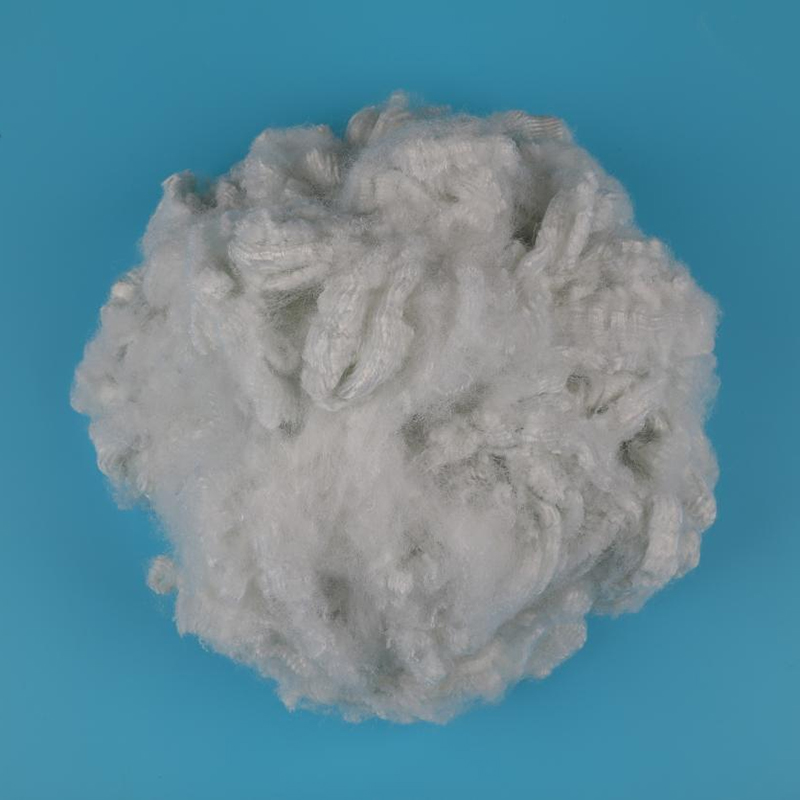
Hollow Conjugated Polyester Fiber Manufacturer: A Comprehensive Guide for Textile and Nonwoven Fabric Purchasers
2026-03-08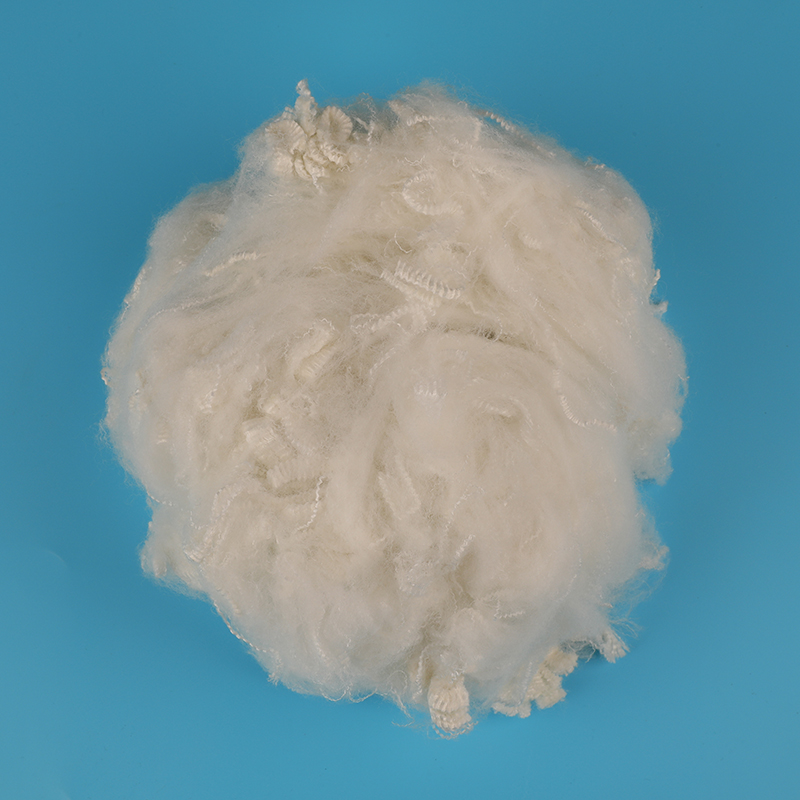
Polyester Staple Fiber vs Polyester Filament: What's the Difference and When Does It Matter?
2026-03-22Your email address will not be published. Required fields are marked *

Focusing to the research and production of differentiated fiber. Applying recycle-material processing scientifically.
 86-18457317878
Zhulinjizhen, Xinfeng Town, Jiaxing City, Zhejiang Province
Copyright @ 2023 Jiaxing Fuda Chemical Fibre Factory All rights reserved
Polyester Staple Fiber Manufacturers

Friendship link - Anhui Fulin Environmental Protection Technology Co., Ltd.:https://www.ahflhb.com