en
 English
 中文简体
 Español
 عربى

Product Consultation
Your email address will not be published. Required fields are marked *
A needle-punched nonwoven line running 1.5D PE/PET bicomponent fiber tells you whether the material is stable inside one working shift. A sheath thickness that drifts by five percent shows up as drum wraps, uneven bonding and web breaks hours before it shows up in a lab certificate, and by then a container is already on the water.
A bicomponent fiber is a staple fiber extruded from two polymers inside one filament, most often a polyethylene (PE) sheath around a polyethylene terephthalate (PET) core. The lower-melting sheath bonds to neighbouring fibers during thermal treatment while the higher-melting core holds the tensile structure, so a single specification error changes both bonding behaviour and hand feel.
Most buyers reach this decision after a first qualification round, when two or three samples all perform well and the real question becomes whether the supplier can repeat that performance across twenty tonnes rather than twenty kilograms. That is the moment a bicomponent fiber supplier has to be judged on evidence instead of sample boxes.
PE/PET and PE/PP bicomponent fibers are not interchangeable, and the pair you accept determines bonding temperature, hand feel and which recycling stream the finished product can enter.
PE/PET dominates thermal-bonded nonwovens and needle-punched felts, where the PET core carries the load. PE/PP suits hygiene topsheets and products that need a softer, more chemically resistant structure, because a polypropylene core is less stiff than PET. A supplier that quotes both pairs at the same price without asking which one you run has not asked enough questions. The way the sheath and core interact during bonding changes web strength more than the headline denier does, and the reference notes on PE/PP bicomponent fiber characterization are worth reading before you lock a polymer pair into a specification.
| Criterion | PE/PET fiber | PE/PP fiber |
| Sheath polymer | PE, melting between 120 and 135 degrees Celsius | PE, same sheath behaviour |
| Core polymer | PET, stable to roughly 250 degrees Celsius | PP, softening near 160 to 170 degrees Celsius |
| Bonding window | Wide, forgiving on oven fluctuation | Narrower, needs tighter temperature control |
| Hand feel | Firmer, crisper | Softer, more drape |
| Typical denier | 1.5D to 6D | 1.5D to 6D |
| Recycling fit | Compatible with PET and rPET streams | Suits polyolefin streams |
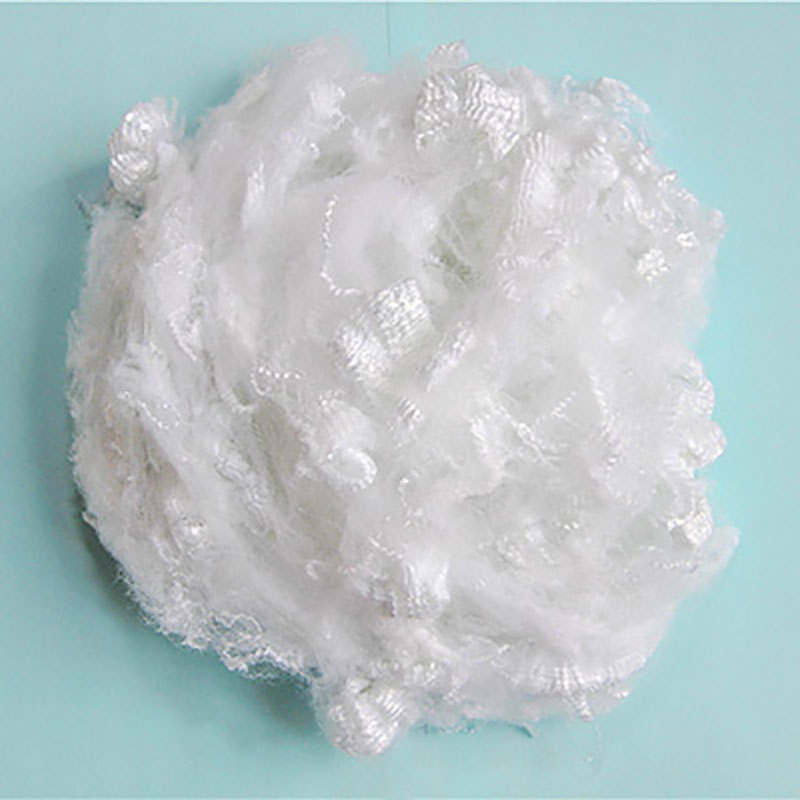
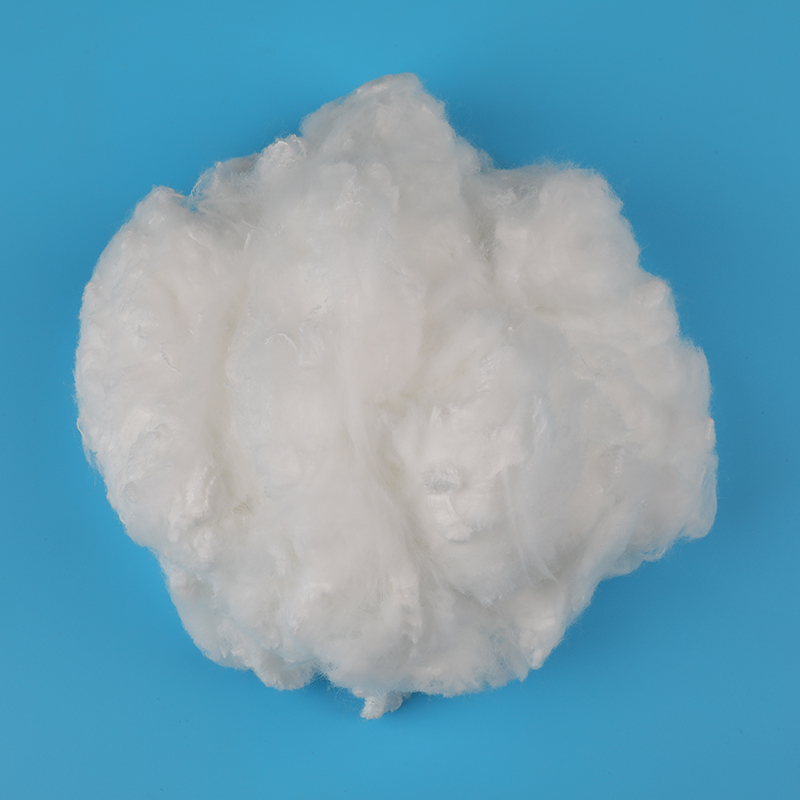 PE/PET Single Hydrophilic White 1.5D×38 Bi-Component FiberInquiry Please fill in carefully, it will help us all!View Product →
Most supplier disputes trace back to three numbers on the specification sheet rather than the polymer itself, and each of them has a measurable effect on carding efficiency, web uniformity and bonding strength.
A 1.5D fiber offers more surface area per gram and therefore more bonding points, which raises tensile strength but also raises the risk of nep formation on a card with worn wire. A 6D fiber opens more cleanly and cards faster but reduces the number of bond points in the web. Holding denier inside a narrow band across shipments matters more than the nominal value printed on the certificate.
Thirty-eight millimetres is the working standard for carded and airlaid lines, 51 millimetres for needle-punched nonwovens, and 64 to 76 millimetres for heavier needled felt where fiber entanglement rather than thermal bonding carries the load. A supplier that ships 51 mm against a 38 mm specification will not always fail incoming inspection, but the line will run badly and the waste rate will show it.
Single-hydrophilic, multi-hydrophilic and water-repellent grades use different spin finishes applied at different points in the process. A multi-hydrophilic grade keeps recovering moisture transport after repeated compression, which matters for absorbent hygiene products. A water-repellent grade is used where the fiber itself must stay dry, such as filtration and protective packaging layers. Whitening and brightening variants change appearance rather than behaviour, but they cannot be mixed into the same production run without a visible shade shift.
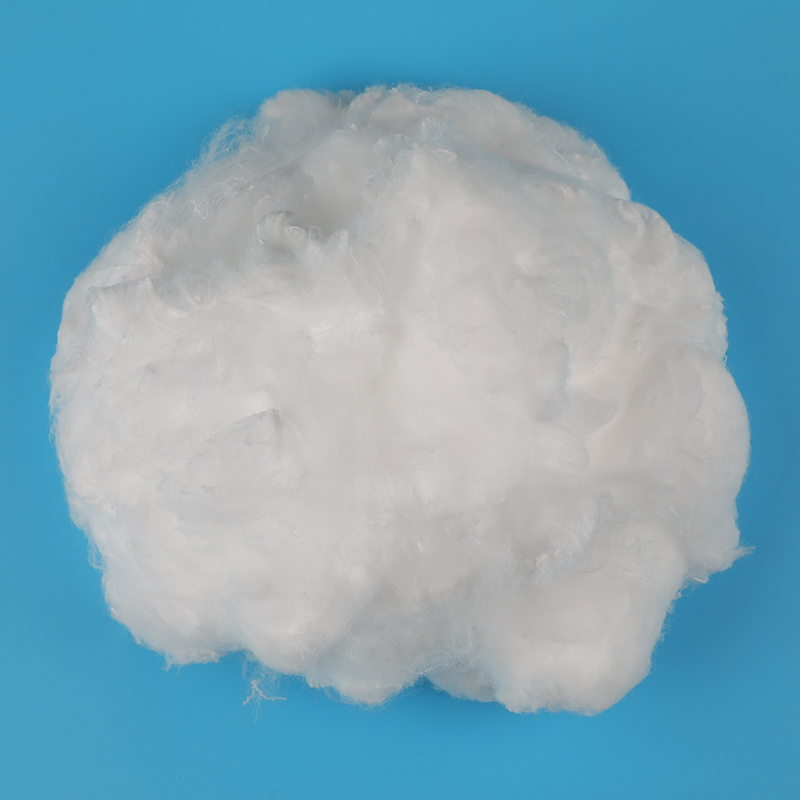 PE/PET Water-Repellent Whitening 2D×38 Bi-Component FiberInquiry Please fill in carefully, it will help us all!View Product →
A recycling claim is only as strong as the traceability behind it, and a certificate number on a website is not traceability.
Two documents carry most of the weight in this category. The Global Recycled Standard (GRS) covers recycled content and chain of custody, while OEKO-TEX certification addresses restricted substances in the finished fiber. Both are meaningful only when they can be matched to a specific shipment through a transaction certificate and an input declaration naming where the recycled flake or pellet came from. Suppliers that control the recycling step themselves close the loop without an intermediary. Jiaxing Fuda Chemical Fibre Factory runs a PET bottle flake recycling plant in Huaibei, Anhui, with a stated annual intake of 50,000 tonnes, feeding recycled polyester staple fiber into the same group of production lines.
Ask for the certificate, then ask which shipment it covers. The second question separates a working management system from a scanned PDF that gets forwarded to every inquiry.
Capacity is only useful once it is converted into your share of a single line, because a supplier with 160,000 tonnes of annual output can still be a poor fit if your volume is spread across whichever line happens to be free that week.
Four composite fiber lines and seven recycled polyester staple fiber lines sit behind the published output figures, and the numbers are specific enough to audit: roughly 40,000 tonnes of composite staple fiber, 110,000 tonnes of polyester staple fiber and 10,000 tonnes of electrostatic flocking tow per year, on a site above 180,000 square metres with a workforce over 1,030. The right question during qualification is not how much a plant can make, but what percentage of one line a 200-tonne monthly order occupies, and which other customers share that line.
Two suppliers who pass the same specification rarely perform the same over twelve months, because consistency comes from process control and line assignment rather than from the data sheet.
Weight those two lists before you start scoring, and weight consistency above price whenever the fiber feeds a line you cannot afford to stop. A one percent saving on material disappears the first time an unplanned stoppage costs a full shift.
Process consistency, measured as lot-to-lot variation in denier, cut length and finish. Price and certification can be verified once at the start of a relationship, but consistency has to hold on every shipment, and it is the hardest factor to recover if a supplier does not control it in the first place.
PE/PET is the usual choice for needle-punched felt, because the PET core keeps tensile strength after needling and offers a wider thermal bonding window. PE/PP remains viable when softness or chemical resistance is the priority, but the narrower bonding window demands tighter oven control and a more stable fiber supply.
Global Recycled Standard certification with a transaction certificate for the specific shipment, plus OEKO-TEX documentation covering restricted substances. Ask for the input declaration that identifies the recycled flake or pellet source, and confirm that the certified recycled percentage matches the fiber actually delivered.
Order three consecutive lots from the same production line and compare the coefficient of variation on denier and cut length instead of the average. Run every lot through identical carding and bonding settings, then record web breaks, nep counts and tensile results. Three lots that behave the same way tell you more than any sample box.
Your email address will not be published. Required fields are marked *

Focusing to the research and production of differentiated fiber. Applying recycle-material processing scientifically.
 86-18457317878
Zhulinjizhen, Xinfeng Town, Jiaxing City, Zhejiang Province
Copyright @ 2023 Jiaxing Fuda Chemical Fibre Factory All rights reserved
Polyester Staple Fiber Manufacturers

Friendship link - Anhui Fulin Environmental Protection Technology Co., Ltd.:https://www.ahflhb.com